.jpeg)
Hindu Succession Act & Daughters’ Coparcenary Rights — Latest Supreme Court Updates

Abstract
The Hindu Succession Act, 1956 (HSA) stands as a landmark legislation aimed at reforming and codifying the intestate succession laws for Hindus. However, its most profound and transformative evolution has been in the realm of coparcenary rights for daughters. For decades, the Mitakshara coparcenary, a traditional system of joint family property, excluded daughters from being coparceners, reserving the right of birth in the joint family property only for sons. This paper provides a comprehensive analysis of the journey of daughters’ rights from exclusion to substantive equality, focusing on the pivotal 2005 amendment to the HSA and the subsequent, clarifying judgments of the Supreme Court of India. It delves into the judicial pendulum that swung from the initial confusion post-2005 to the final, authoritative settlement in Vineeta Sharma v. Rakesh Sharma (2020). The article details the core principles established: the conferment of equal coparcenary rights upon daughters by birth, irrespective of whether their father was alive on the date of the 2005 amendment; the retrospective nature of these rights; and the impact on partitions and testamentary dispositions. It further examines the consequential effects on succession, taxation, and the very structure of the Hindu Undivided Family (HUF). By tracing this legal trajectory, the article underscores the Supreme Court’s role in transforming a patriarchal provision into a powerful instrument of gender justice, affirming the daughter’s position as a coparcener in her own right, with all attendant liabilities and entitlements.
Introduction
The concept of coparcenary under the Mitakshara school of Hindu law is a unique and ancient institution. It represents a common ownership interest in joint family property, held by a group of male descendants (coparceners) up to three generations from a common male ancestor—the father, sons, grandsons, and great-grandsons. This system, defined by the principle of survivorship (jus accrescendi) rather than succession, inherently discriminated against female members. A daughter, upon marriage, was considered part of her husband’s family, while a wife or mother had only a right to maintenance, not ownership.
The Hindu Succession Act, 1956, initially made only incremental changes to this patriarchal structure. While it granted daughters absolute ownership over property acquired from a father who died intestate (Section 10), it left the core of the Mitakshara coparcenary largely untouched under Section 6. The daughter remained a stranger to the coparcenary, not acquiring an interest by birth.
The movement for gender equality within property rights gained momentum towards the end of the 20th century, leading to the enactment of the Hindu Succession (Amendment) Act, 2005. This amendment fundamentally altered Section 6 of the HSA, declaring the daughter of a coparcener to be a coparcener by birth in her own right, “in the same manner as the son.” The text of the law seemed clear, but its interpretation sparked a decade and a half of intense legal debate and conflicting judicial pronouncements. The central controversy revolved around two key issues: the retrospective application of the amendment and the status of the father (the coparcener through whom the daughter claimed rights) on the crucial date of September 9, 2005 (the enactment date).
The Supreme Court’s journey through cases like Prakash v. Phulavati (2015), Danamma @ Suman Surpur v. Amar (2018), and finally, the constitution bench judgment in Vineeta Sharma v. Rakesh Sharma (2020), represents a critical chapter in Indian jurisprudential history. This article provides a detailed examination of this evolution, unpacking the legal nuances, the conflicting interpretations, and the ultimate, unequivocal affirmation of daughters’ rights as coparceners. It goes beyond the core ruling to explore its wide-ranging implications on pending lawsuits, partitions, wills, tax laws, and the social fabric of Hindu families, concluding that the legal battle for coparcenary equality has been decisively won, though its social assimilation remains an ongoing process.
1. The Legal Landscape Pre-2005: Exclusion as the Norm
Prior to the 2005 amendment, the legal position was unequivocal. Section 6 of the unamended HSA, 1956, recognized the Mitakshara coparcenary with its male-only membership. The explanation to the old Section 6 defined a coparcener as a male member. A daughter had no right by birth. Her rights were limited:
» Upon Father’s Intestate Death: She became a Class I heir under the Schedule to the Act, inheriting a share equally with the widow, son, and mother, but this was a share in the separate property of the father or in his notional share of the coparcenary property upon a deemed partition.
» Right to Claim Partition: Only after the death of a coparcener, his female heirs (like the daughter) could inherit his share, but they could not demand partition while the male coparcener was alive.
» The Notional Partition: The proviso to old Section 6 stated that when a male Hindu died after the commencement of the Act, his interest in the Mitakshara coparcenary property would devolve by succession (under the Act) and not by survivorship, provided he had left behind a female relative of a Class I heir or a male relative claiming through such female heir. This was a significant inroad but still did not make the daughter a coparcener.
This legal framework perpetuated economic dependence and social subordination of women, contrary to the constitutional mandate of equality (Articles 14 & 15) and the dignity of the individual.
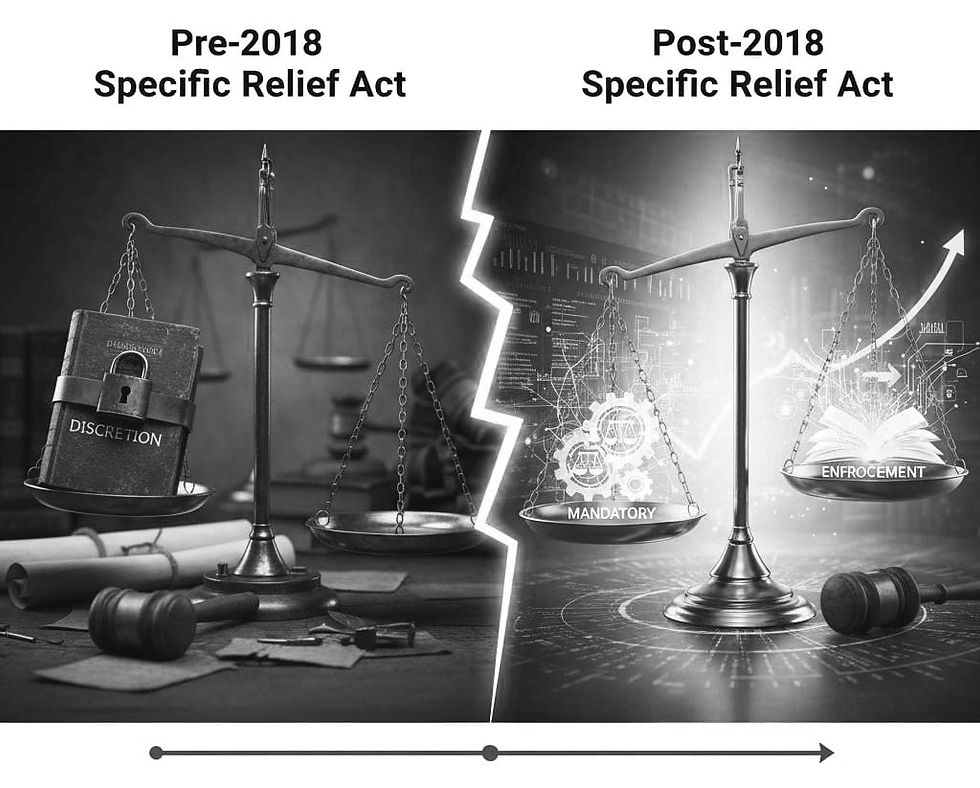
2. The Watershed: The Hindu Succession (Amendment) Act, 2005
Driven by recommendations of the Law Commission (174th Report, 2000) and a growing consciousness of gender justice, Parliament enacted the 2005 amendment. The new Section 6 was revolutionary:
» Section 6(1): “On and from the commencement of the Hindu Succession (Amendment) Act, 2005, the daughter of a coparcener shall by birth become a coparcener in her own right in the same manner as the son.”
» Section 6(2): The daughter now has the same rights and liabilities in the coparcenary property as the son.
» Section 6(3): She can dispose of her share by will or other testamentary disposition.
» Proviso to Section 6(3): It protects any disposition or alienation (including partition) which had taken place before December 20, 2004 (the date of introduction of the Bill in Parliament).
» Explanation: Clarifies that this section applies whether the daughter is married or not.
» The intent was clear: to end gender discrimination in the coparcenary. However, the phrase “on and from the commencement” and the absence of a clear transitional provision became the source of protracted litigation.
3. The Judicial Conundrum: Conflicting Interpretations
The Supreme Court grappled with the application of the amended law, leading to a trilogy of significant rulings.
A. The “Living Coparcener” Doctrine: Prakash v. Phulavati (2015)
A two-judge bench interpreted the amendment as having a prospective application. It held that the rights under the amended Section 6 accrued only if both the daughter and the father (the coparcener through whom she claimed) were alive on the date of commencement (September 9, 2005). If the father had died before this date, the coparcenary had already crystallized, and the daughter’s rights would be governed by the unamended law. The phrase “daughter of a coparcener” was read to mean a living daughter of a living coparcener as of September 9, 2005. This judgment severely limited the amendment’s reach, excluding vast numbers of daughters whose fathers had died prior to 2005.
B. The Ambiguous Deviation: Danamma @ Suman Surpur v. Amar (2018)
Another two-judge bench, in what appeared to be a factual contradiction to Phulavati, ruled in favor of daughters whose father had died in 2001. The court seemed to hold that the amendment was retrospective in nature and that the daughters’ rights were not contingent on the father being alive in 2005. However, the judgment did not expressly overrule Phulavati and contained observations that created confusion rather than clarity. This led to a situation where two co-equal benches had delivered seemingly contradictory rulings, leaving lower courts in a quandary.
C. The Final Settlement: Vineeta Sharma v. Rakesh Sharma (2020)
To resolve the conflict and authoritatively settle the law, a three-judge bench referred the matter to a Constitution Bench. The landmark judgment by Justice S. Abdul Nazeer, for a unanimous bench, overruled Phulavati, clarified Danamma, and laid down the law with finality.
4. The Supreme Court’s Authoritative Pronouncement in Vineeta Sharma: Core Principles
The Vineeta Sharma judgment is the cornerstone of modern coparcenary law. Its holdings are comprehensive:
» Daughters are Coparceners by Birth: The right is conferred by birth. It is not created by the 2005 amendment; the amendment merely recognized a pre-existing right that was previously denied. The source of the right is birth, not the amendment.
» Rights are NOT Prospective but Retrospective in Nature: The court held that the amended Section 6 applies retrospectively. The phrase “on and from the commencement” was interpreted to mean that the provision is to be applied to all daughters born before or after the amendment, as long as they were alive on September 9, 2005. The status of being a coparcener is conferred from the date of the daughter’s birth, but the legal enforceability of this right crystallized from the date of the amendment.
» Father’s Survival on 09.09.2005 is Irrelevant: This is the most crucial holding. The court explicitly overruled the “living coparcener” requirement from Phulavati. The daughter’s right is inherent and by birth. It is not derived through the father. Therefore, whether the father through whom she claims coparcenary rights was alive on September 9, 2005, is immaterial. The only condition is that the daughter herself must have been alive on that date.
» Impact on Partitions: Any partition that took place by decree of a court or by a registered instrument prior to December 20, 2004, is saved and remains valid (as per the proviso). However, any oral or unregistered partition, even if alleged to have taken place before this date, is irrelevant. If a partition is not evidenced as per the proviso, the daughter’s coparcenary share remains intact and she can claim re-partition.
» No Requirement of the Coparcenary to Exist in 2005: The court clarified that the coparcenary need not be in existence as a joint family in 2005. The right, being inherent, traces back to the birth of the daughter. Even if the father had separated from the joint family or had passed away earlier, the daughter’s right, once vested from her birth, remains.
5. Legal and Practical Implications of the Vineeta Sharma Ruling
The judgment has far-reaching consequences across multiple domains:
» Revival of Dead Claims: Lawsuits that were dismissed based on Phulavati (where the father died pre-2005) can now be revived. The limitation period for filing such claims will be calculated from the date of the Vineeta Sharma judgment (August 11, 2020) for those whose cases were time-barred based on the earlier incorrect law.
» Invalidation of Oral Partitions: Families that relied on oral family arrangements to exclude daughters now find those arrangements legally vulnerable. Daughters can challenge such partitions and claim their rightful share.
» Testamentary Dispositions: A coparcener (father or brother) can only will away his undivided share in the coparcenary property. After Vineeta Sharma, the father’s share is determined after notionally allotting the daughter her birth-right share. He cannot will away property that lawfully belongs to the daughter as a coparcener.
» Taxation and Hindu Undivided Family (HUF): For tax purposes under the Income Tax Act, 1961, an HUF includes both male and female members. A daughter, as a coparcener, can now be the Karta (manager) of the HUF—a position affirmed by the Delhi High Court in the 2015 Suo Motu writ petition. This has significant implications for HUF formation, tax planning, and management of joint family assets.
» Liabilities Attached to Rights: The judgment emphasizes that daughters have not just rights but also liabilities. They are equally liable for the debts of the coparcenary to the extent of their share in the property.
» Social Transformation: The ruling strengthens the economic agency of daughters, moving them from the periphery to the center of the family’s proprietary structure. It challenges deep-seated social norms and empowers daughters to be equal stakeholders.
6. Continuing Challenges and Ambiguities
Despite its clarity, some practical and interpretative challenges persist:
» Onus of Proof: In cases of alleged pre-2004 partitions, the burden of proving a valid, registered partition lies on those claiming exclusion of the daughter.
» Granddaughters’ Rights: The judgment firmly establishes the daughter’s right. The rights of a granddaughter (through a predeceased son) would typically flow through her father’s share. If her father (the son) had a right, she inherits it upon his death as a Class I heir, but the nature of her interest (whether as a coparcener or an heir) in the larger joint family may involve complex layering of claims.
» Step-Daughters and Adopted Daughters: The Act applies to daughters by full blood, and adopted daughters have equal rights. The position of step-daughters may depend on specific familial relationships and interpretations.
» State-Specific Variations: The amended Section 6 does not apply to states like Tamil Nadu, which had already enacted similar reforms earlier (2001) with potentially different wordings and conditions.
7. Conclusion: A New Era of Gender Justice
The Supreme Court’s verdict in Vineeta Sharma v. Rakesh Sharma is a definitive and triumphant conclusion to a 15-year period of legal uncertainty. It represents a robust judicial affirmation of constitutional values over archaic personal law traditions. By decisively holding that a daughter’s coparcenary rights are inherent, inalienable, and traceable to her birth, the Court has not merely interpreted a statute but has catalyzed a profound social change.
The journey from the discriminatory Mitakshara coparcenary to the equal coparcenary under the amended Section 6 of the HSA illustrates the dynamic interaction of legislature and judiciary in the pursuit of gender justice. The 2005 amendment provided the text, and the Supreme Court, through Vineeta Sharma, provided the authoritative interpretation that fulfills its spirit. The daughter is no longer a paraya dhan (someone else’s wealth) but a legal equal in the ancestral home, entitled to her share of the legacy and burdened equally with its responsibilities. This legal evolution marks a critical step towards substantive equality for Hindu women in India, ensuring that the right to property is no longer determined by gender. The implementation of this right in the social and familial sphere remains the next frontier, but the legal battle for coparcenary equality has been unequivocally won.
Here are some questions and answers on the topic:
1. Q: What was the central legal confusion regarding daughters' coparcenary rights after the 2005 amendment to the Hindu Succession Act, and how did the Supreme Court resolve it in the Vineeta Sharma case?
A: The central legal confusion after the 2005 amendment revolved around its applicability—specifically, whether the daughter's equal coparcenary rights depended on her father (the coparcener through whom she claimed) being alive on the date of the amendment's commencement, September 9, 2005. This confusion was created by conflicting Supreme Court rulings. In Prakash v. Phulavati (2015), the Court held that the amendment was prospective, requiring both the daughter and the father to be alive on September 9, 2005, for the daughter to claim rights. Conversely, Danamma @ Suman Surpur v. Amar (2018) appeared to grant rights even when the father had died earlier, creating a contradiction. The Supreme Court resolved this conflict definitively in Vineeta Sharma v. Rakesh Sharma (2020) by overruling the Phulavati judgment. The Constitution Bench held that the daughter's right as a coparcener is acquired by birth; it is not created by the 2005 amendment but merely recognized by it. Therefore, the father's survival on the date of the amendment is completely irrelevant. The only condition is that the daughter claiming the right must have been alive on September 9, 2005. This judgment established the retrospective application of the amendment and settled the law with finality.
2. Q: Explain the key difference between a daughter's right to ancestral property before and after the 2005 amendment, focusing on the concept of the coparcenary.
A: Before the 2005 amendment, a daughter's right to ancestral Mitakshara coparcenary property was not that of a coparcener. The coparcenary was a body of male members only—the father, son, grandson, and great-grandson—who owned the property by birth and had the right to seek partition. A daughter had no birthright in this joint family property. Her right was only that of a beneficiary upon the death of a coparcener. If her father died intestate, she could inherit a share in his separate property or in his notional share of the coparcenary property as a Class I heir, alongside her mother and brothers. However, she could not demand partition during her father's lifetime. After the 2005 amendment, as interpreted by the Supreme Court in Vineeta Sharma, the daughter's position was transformed. She is now a coparcener "in the same manner as the son" by virtue of her birth. This means she has a right by birth in the coparcenary property itself, not just a right to inherit upon death. She is a joint owner, can demand partition during her father's lifetime, has equal liabilities, and can dispose of her share through a will. Her right is inherent, independent, and equal from the moment of her birth.
3. Q: How does the Vineeta Sharma judgment impact partitions of Hindu Undivided Family (HUF) property that were executed before the 2005 amendment?
A: The Vineeta Sharma judgment has a significant but carefully calibrated impact on pre-2005 partitions. The ruling protects certain completed partitions but invalidates others that were informal. The proviso to the amended Section 6 of the Hindu Succession Act explicitly saves any partition that was effected by a decree of a court or by a registered instrument duly executed before December 20, 2004 (the date the amendment bill was introduced in Parliament). Such legally documented partitions remain valid, and a daughter cannot reopen them to claim a share. However, the judgment renders oral partitions or family arrangements that were not formalized through a registered document legally vulnerable and ineffective against the daughter's claim. If a partition is alleged to have taken place before December 20, 2004, but is not evidenced by a court decree or registered instrument, the law deems the coparcenary as still being in existence. In such cases, the daughter's coparcenary share remains intact, and she is fully entitled to approach the court to claim her rightful share, effectively demanding a fresh partition that includes her.
4. Q: Beyond ownership, what are the broader legal and practical implications of a daughter being recognized as a coparcener?
A: The recognition of a daughter as a coparcener extends far beyond mere ownership of a property share, triggering wide-ranging legal and practical implications. Firstly, it affects testamentary succession. A coparcener can only will away his or her own undivided share. Therefore, a father can no longer will away the entire coparcenary property, as a portion of it already belongs to the daughter by birth. Secondly, it alters the management structure of the Hindu Undivided Family (HUF). A daughter, as a coparcener, is legally entitled to become the Karta (the manager) of the HUF, a role traditionally reserved for the eldest male member. This has been affirmed by various High Courts. Thirdly, it brings equal liabilities. The daughter is equally liable for the debts and obligations of the coparcenary, to the extent of her share in the property. Fourthly, it has direct tax implications, as the daughter's status as a coparcener affects the computation of income and assets under the HUF for income tax purposes. Finally, on a practical and social level, it strengthens the daughter's economic agency, empowers her in familial decision-making, and challenges deep-rooted patriarchal norms by placing her at the core of the family's proprietary structure.
5. Q: Did the Vineeta Sharma judgment make the 2005 amendment applicable to all daughters unconditionally? If not, what are the key conditions and exceptions?
A: No, the Vineeta Sharma judgment did not make the amended law applicable to all daughters unconditionally. While it greatly expanded its scope, it outlined specific conditions and saved certain exceptions. The key condition established is that the daughter must have been alive on the date of the commencement of the amendment, i.e., September 9, 2005. If a daughter had passed away before this date, her heirs could not claim coparcenary rights through her under the amended law. The primary exception, as saved by the statutory proviso, is for partitions that were legally finalized before December 20, 2004, via a court decree or a registered partition deed. Daughters cannot challenge such completed partitions. Furthermore, the judgment does not apply to testamentary dispositions. If a coparcener had lawfully willed his separate property or his share of the property (as determined under the old law) before his death, that disposition is governed by the law of wills and is not undone by this judgment. Lastly, the amended Section 6, as interpreted by Vineeta Sharma, does not automatically apply in states like Tamil Nadu and Kerala, which have their own distinct legislative histories concerning Hindu succession and the coparcenary system.
Disclaimer: The content shared in this blog is intended solely for general informational and educational purposes. It provides only a basic understanding of the subject and should not be considered as professional legal advice. For specific guidance or in-depth legal assistance, readers are strongly advised to consult a qualified legal professional.


Comments